Over the years, many educationalists (Dewey 1958, MacGurie
1966, Bramley 1977, Tough 1971, Moore 1973, Sheehan 1981, Knowles 1980, Gagne
1977, Quinn 1989, Earwaker 1992, Peelo 1994) have provided literature,
discussing the roles and responsibilities of a teacher. Some of their work will
be reviewed in this section. Dewey (1938) explained that the teacher needs to
be aware of the capacity, needs and past experiences of the students so that
she can make suggestions for learning. The teacher should use the environment
and experience to promote learning, as well as select activities, which will
encourage learners to organise knowledge and gain from the experience. The
teacher needs to look ahead to see the direction in which the learning
experience is leading the student, to ensure that the learning experiences are
conducive to continued personal and professional growth and development of the
learner.
According to Tough (1971 cited by Moore 1973 pp 670) the
teacher is a helper, whose function is ‘providing information, advice (or
suggestions and recommendations), and reasons that help the learner to make the
decisions and understand the reasons for it.’
The helper provides detailed information about the various possibilities
that are open to the learner, but lets the learner himself make the decisions.
While the tutor facilitates and guides learning, she should not interfere with,
nor control the process of learning (Dewey cited by Jarvis 1992) as the learner
can obtain a great deal of help without giving up control or responsibility to
the teacher. This is very evident in the Inquiry
Based Learning approach.
The need for an adult learner to maintain control over own
learning has been emphasised by Knowles (1980) in his model of andragogy
as discussed in an earlier blog. Perraton (1981 pp 14 - 15) concurs with this
concept, as he states that 'learning is more effective if, through dialogue
between student and teacher, the student can be shown how the new matter he is
learning relates to what he already knows, and relates to his environment.'
Understanding of this relevance is based on individual perception, so this
'dialogue' may have to be, often, carried out between personal tutor and
student, so that the student understands the relevance of the curriculum to
their chosen profession / career.
As Lewis (1984) proposed, this allows the tutor to recognise
the support the learner may need. The tutor is responsible for assessing the
individual’s strengths and weaknesses (Keegan 1980). She will follow the
student throughout the course, be available for consultation, hold tutorials
and maintain a record of progress. These are similar to the responsibilities of
the facilitator in the IBL
process. Hiyola & Moss (1989) point out, that the tutor's role encompasses:
* Tutoring,
that is related to academic problems of learners;
* Tutoring
oriented to general study
skills;
* Dealing with general problems which
arise from students working with the educational system and
* Counselling of students.
However, the term counselling can be misleading, as this is
not a therapeutic situation but an advisory role. The former is a service
provided by student services. The
success of the role would therefore appear to be based on a good interpersonal
relationship between the student and the personal tutor. Quinn (1995) cites
Nelson-Jones (1993) in describing the term counselling as a helping
relationship, a set of activities and methods, and a special area for providing
services. This encompasses the development of a non-threatening relationship
which will enable the student to discuss his / her problem, so that the tutor
can help the student to explore solutions to it.

Bramley (1977, pp 21) states ‘The essence of personal
tutoring is good teaching - exciting, mind-expanding teaching .......... it is
safe to assume that an inspired, committed teacher will, through his teaching,
spark off a warm response in most of his students. It is the reciprocity of
feeling, which marks the beginning, middle and end of personal tutoring.’ The
teacher will be successful in her role, if she is able to establish a good
interpersonal relationship with the learner (Bruner 1968, Dallos 1984, Quinn
1989) by maintaining a two-way communication (Wedemeyer 1977, Baath 1979, Tough
1979, Perraton 1981, Rumble 1989) and being genuine in her transactions
(Bramley 1977). There must be mutual understanding and acceptance (Dallos 1984)
so that the student is able to relax and have total confidence in their tutor
(Peelo 1994). Tough (1979) is of the opinion, that to establish and maintain a
good relationship, the teacher has to:
• be warm
and loving;
• have
confidence in the learner's ability;
• always be
prepared to enter in a genuine dialogue with the learner; and
• have a
strong motivation to help and be an open and growing person.
Riseborough (1994) agrees with Tough (1979) in stating that
a good relationship increases motivation and confidence in students. Peelo
(1994) explains that the tutor helps the student to define her situation, by
listening with care and kindness, in a quiet peaceful atmosphere, so that the
student gets an impression of warmth and kindness. The importance of this
quality of warmth and genuineness is also emphasised by Moore (1973), Nyirenda
(1989), Rogers (1986), and Perraton (1984).
While the nature of the relationship and the contribution of
the tutor to the relationship have been discussed, consideration also needs to
be given to the role of the student within this relationship. The student is
responsible for making appointments with her tutor, to avail necessary tutorial
support. However, it appears that the onus of establishing the relationship and
creating the appropriate environment, appears to be on the tutor even while
equality within the relationship is being advocated by educationalists like
Bramley (1977, pp 15) “a sense of belonging, growing out of shared beliefs and
endeavours, which turns eventually into comradeship.”
Another issue important to the relationship is
confidentiality (Peelo 1994). She states that being able to communicate freely
comes from the knowledge that you can say anything to the tutor and be assured
that it will not become public knowledge. Therefore, guaranteed of
confidentiality, the student will be able to discuss their hopes, fears,
failures, doubts, and anxieties.
While explaining the role of the personal tutor within
general education, Bramley (1977) states that “personal tutoring is an attitude,
not a set of prescriptions” (pp 21). The students have freedom to develop their
academic abilities. Peelo (1994) holds the view that the role of the tutor is
to support and help students to develop their confidence in their academic work
and in fulfilling personal ambitions. This can be achieved by suggesting
varying studying techniques to build personal approach to study, thus allowing
the student to develop an ‘academic identity’ without ‘compromising the
student’s autonomy’ (pp. 3).
However, within professional education the students along
with achievement of academic standards also have to develop and maintain
professional standards, which have been stipulated by the professional body for
the safety of the public. The understanding of the curriculum and the relevance
of the subjects studied will improve the motivation of students and help to
maintain professional standards, which underpin the curriculum. The extent of
guidance required by student changes as the student develops increasing
expertise, as the course progresses. Quinn (1995) therefore, feels that the
role of the tutor will also change in the same vein, as the student becomes
more independent.
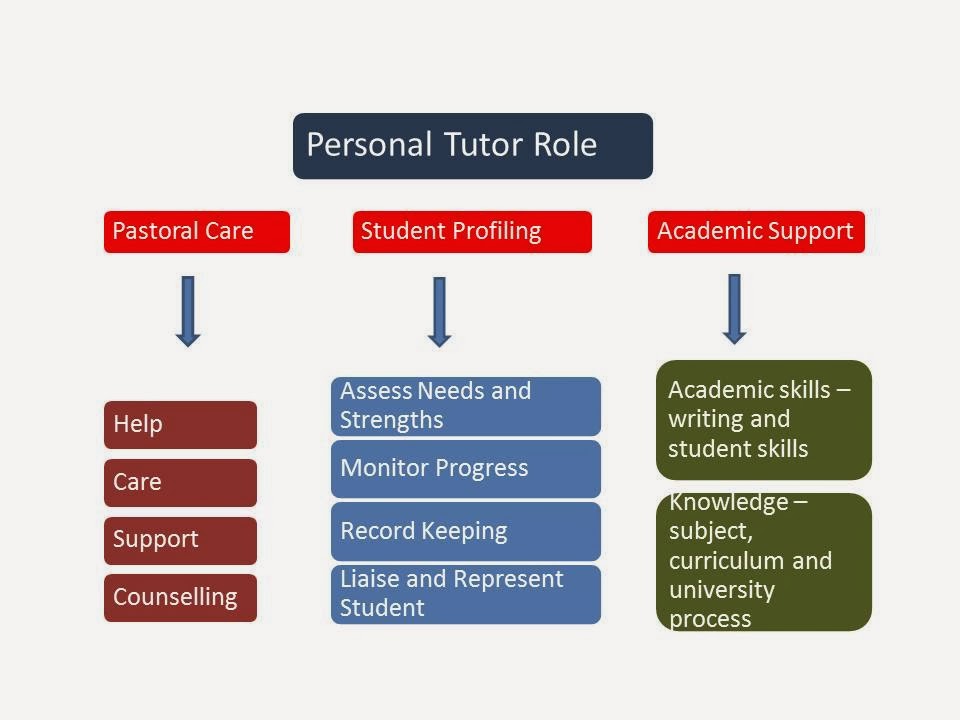
According to Quinn (1989 pp 414) the role of the personal
tutor comprises of :
• encouraging
and supporting
• informing
and advising
• monitoring
and coaching / counselling
• liasing
and representing
• negotiating
• record
keeping and references
• as well
as disciplining.
Bewley (1995) feels that it is essential for students to
have a personal tutor, who will be able to provide individualised support to
the student. This is confirmed by the findings of Richardson (1996) that a
personal tutor is the first stop for a student who wants help. Similarly
Earwaker (1992) states that pastoral care and one to one contact will provide
personal attention.
The tutor is a learning resource for the students, who will
inform and advise students regarding their course work and assessment (Quinn
1995). The tutor monitors the progress of the student, by liaising with other
staff members during the course and gives feedback to the student. This allows
the tutor to give remedial or additional teaching, if required. One of the ways
of doing this is through negotiated learning
contracts (Keyzer 1986, Riseborough 1994) with the student. The use of
learning contracts should enable the students to become independent and self-directed
in their studies as well as become reflective practitioners (Crotty 1993). The
earlier mentioned ‘dialogue’ between student and tutor can be used to reflect
on student experiences, both academic and practical.
As Kolb (1984) clarifies reflection is not a new concept, but
the use of an appropriate reflective
cycle is essential to maintain and improve standards of clinical
practice. Schon (1983) points out
reflection can be in action and on action. The former is the reflection carried
out as the behaviour is taking place, to decide the next action, while the latter
is carried out in retrospect, where actions are reviewed along with the
underpinning knowledge. The personal tutor can assist the student in carrying
out this reflection on action, and to complete the learning log, that is often
a part of the practical assessment. This, according to Gallego and Walter
(1991, cited by Newton and Smith 1998) enables the personal tutor to facilitate
students in bridging the theory practice gap, so that the student becomes an
autonomous, accountable professional.
The tutor needs to be aware of her own strengths and
weaknesses. Certainly the tutor is unlikely to be a specialist in every subject
that the student is undertaking. She should therefore, be able to give guidance
and direction to the student regarding the resources available and their
appropriate and effective use. “Personal tutor is responsible for keeping a
watchful eye on the student’s work and progress on an individual basis.”
(Earwaker 1992, pp. 45 - 46)
The role of the personal tutor also includes record keeping
through student profiling, which embodies ‘a wide range and diverse range of
assessments of knowledge, skills and experiences.’ (Miller 1982, cited by Quinn
1995, pp. 204) The advantages of profiling as discussed by Hitchcock (1990) are
as follows :
• Recording of student progress with emphasises
on achievements and thereby providing students with motivation.
• To maintain records, the tutor and
student require one to one communication. This also encourages the development
of relationship between the two.
• The improved relationship and close
interaction facilitates pastoral care, as and when appropriate.
• It also
enables the tutor to identify the learning needs of each student.
• The
record keeping and profiling allow the tutor to provide end of course
references.
Despite the obvious advantages there are some limitations to
this role. Studies carried out by Earwaker (1989a, b) in general education
clearly identify the confusion and uncertainty tutors feel regarding this
supporting role, despite having strong commitment to their learners. Another
aspect revealed by this study was the large number of students each tutor had
to provide support to, some as much as over 100 students! Only a small number
of tutors were providing this support. This high student tutor ratio made the
staff feel burdened by this role. The students’ needs ranged from:
Minor problems like:
• adjusting
to the course
• clarification
of procedural matters
To major problems like:
• serious medical
conditions
• relationship
problems and
• sometimes
psychological problems.
So there is a need to distinguish between the role of the tutor
from that of the counsellor.
Other findings of Earwaker (1992) indicate that some tutors
are seen to be approachable, while others are reluctant to get involved in
student’s personal problems. A number of tutors feel that they are sometimes
overwhelmed by the enormity of the problems brought to them. Though some tutors
were seen to be self-aware regarding lack of appropriate skills, they were not
keen to take up appropriate training due to existing pressure of work. Another
unfortunate aspect is that, the supporting role is viewed by staff to be
inferior to the academic role, as it did not appear to be valued by the
institution. Supporting role of the tutor was seen as ‘a career cul-de-sac’
(Earwaker 1992, pp. 50) for their promotion in the academic world would be
adversely effected if they seriously applied their supporting role, and would
fall behind in research and consultancy which are the performance indicators of
academia. Earwaker’s (1992) work clearly indicates that tutors wished for clear
guidelines regarding this supporting role. Many tutors had an ‘open door’
policy to allow students easy access, which would take up time, making it
difficult to function.
Therefore, the tutors who can give up some other
responsibility will be the ones who can carry on providing the required level
of support through ‘open door’ policy, while others will be unable or unwilling
to do the same. Yet within Higher Education, the personal student – tutor
relationship is attributed by characteristics of:
• flexibility,
• individual
attention and
• pastoral
concern.
Therefore, there is a mismatch between what higher education
states is the role of the personal tutor and the actual provision of this
service to the student. To provide the service, as discussed earlier, there
needs to be sufficient time available to the tutor. With increasing demands
being made on tutor time and the need for raising student number puts
tremendous strain on the tutor. If the system is based on the premise that all
students are adults and should be allowed the freedom to learn, as Rogers
(1983) clearly states, and identify their own needs, the responsibility of
maintaining the relationship should be the student’s rather than the tutor’s.
Some of these concerns can be met with the implementation of the IBL approach
to learning and teaching as the facilitator also acts as the personal tutor for
the group of around 15 students.
Greenwood (1993) has cautioned against reflection on action
as the situation, as well as the articulation, of the conceptual models maybe
distorted by the student. They may articulate what they assume the tutor wishes
to hear and therefore lead to superficial reflection. Earwaker (1992) goes on
to state that there may be role strain with the tutor supporting the student and
being the advocate as well as trying to up hold the standards of the profession
that she is trying to impart to her students. Therefore, it has been suggested
that it would be better if the personal tutor is not involved in the assessment
of the students. But in reality this is not possible. Despite the earlier
discussion in this section, regarding the nature of the student – tutor
relationship, Earwaker (1992) feels that realistically this relationship cannot
be based on equal terms as each occupies a specific role – the tutor who is
presumed to know things that the students do not know as yet. Therefore, the
meeting between the two is based generally on the understanding that the tutor
will:
• offer
advice,
• give
guidance,
• provide
support to the student, and
• make the
relationship a working one.
The tutor can find it difficult to maintain this
responsibility of forming relationship as she will have many students to cater
for and that not all students will be responsive or willing to form the
relationship. This can be true particularly of mature students who have a whole
support network outside of the university and may only require academic
support.
Earwaker (1992) gives the opinion that personal tutoring as
a role, falls in the middle ground between counselling and interviewing as it
is appropriate to draw on skills from both areas to fulfil the role. It must be
remembered that a student may not want a close relationship and may not wish to
discuss personal problems with the personal tutor, because by confiding in the
personal tutor, the student becomes vulnerable to her. To redress this, the
personal tutor may have to be willing to show her own vulnerability to the
student. This can be achieved by referring sparingly to own experiences in a
caring and appropriate manner.
Often cultural and religious differences can lead to
misunderstandings between the student and the personal tutor, as they can
sometimes make discussions on whole areas of life a taboo. There needs to be an
understanding of the student’s cultural and religious background if sensitivity
is to be shown to student’s needs. The tutor can explore these issues by
discussing her own cultural background, particularly if it is different from
that of the student. However, if the student does not wish to discuss her
problems, the tutor must respect this, as there is nothing she can do except
assure the student that she would be willing to listen and help, particularly
with regards to personal matters.
Once in a while the aspect of gender can also be
problematic. Depending on the cultural background, some female students are not
comfortable with a male personal tutor and vice versa. In such cases there will
be limited interaction between the two despite the best intentions of the tutor
in forming a relationship with the student.
Thus, there is fairly extensive discussion on the role of a
teacher within various literature. From this, it can be deduced that the
personal tutor will function within the same parameters in majority of the
professional programs, but in practice varying emphasis on different aspects of
the role are seen, when applied by the personal tutor. This varying emphasis
may be related to the tutor's own perception, preference and experience of
personal tutoring system, both as a learner and as a tutor. The emphasis will
also obviously vary with the needs of the individual student.
There appears to be little information regarding the
perception of the learners about the role of the personal tutor, though some
research has been carried out relating to tutorials and student satisfaction.
(Hiyola & Moss 1989, Akinsanya 1992) If we are to understand the role of
the personal tutor we need to take into account what the learners expect form a
personal tutor so that they can obtain satisfactory support.


